
Stand up. Report blindly to people who aren’t really interested. Leave. Why?
Fifteen minutes. Same time every day. Camera on, ideally. Three questions: what did you do yesterday, what will you do today, any blockers. We’ve been doing this as a ritual for far too many years.
I noticed, as I attended them, that nobody actually wanted to be there. Not the engineers who already knew what they were doing. Not the manager who can read the same updates faster in chat and was up to date. Not the new starter who hadn’t quite worked out what to say yet and was just rehearsing it silently while waiting their turn. Not even the people delivering the updates, who read them off Jira because they finished what they actually wanted to say in the first thirty seconds. I heard so many of my colleagues complaining bitterly and some even tried to twist Agile’s self managing team decisions to vote away standups.
This is the most performed meeting in software, and the performance is stale, over used and not worth the curtain it’s drawn behind. I was at a company that felt that the failure to deliver a project anywhere near the deadline had nothing to do with an over eager sales team and that they just needed to send everyone on a scrum course!
Daily standups came out of XP and early Agile in the late 1990s and early 2000s. They were designed to solve a real problem: co-located teams of seven or eight people who couldn’t otherwise see what their colleagues were doing. Standing up was deliberate — the meeting was meant to be short, fifteen minutes maximum, because nobody wanted to remain on their feet for longer than necessary (I got told off for not standing at some companies, who felt that rigid rules were more important than back ache). The format worked sometimes because it solved a coordination problem that existed in the room you were sitting in. In many cases, this circus was for management to tick the box. Standups were distorted from “reporting to each other” to “reporting to the manager (who knew anyway)” and the best test of this was when a senior stakeholder turned up and everyone would report to them instead - meaningless. Everyone who wanted to be the centre of attention (and be reported to) became a certified scrum master and persisted the performance.
Everything about good and bad standups has changed. The room is gone. The colleagues are remote. The chat tools we use all day have made the information itself flow continuously. And the meetings have stretched — fifteen minutes became twenty, twenty became thirty, and “standup” became a seated affair where everyone is on Zoom and three people are pretending to listen while merging PRs or playing solitaire. During Covid, I worked remotely for a large organisation and was told off at my first meeting for having my video camera on - apparently we weren’t to see each other - for 18 months I never saw any of them!!
We kept the dead rituals while the last remnants of the reasons for the function crumbled to dust.
What the typical standup actually does now - none of which were the original point.
It produces the appearance of coordination. The team meets daily, therefore the team is aligned, therefore everything is fine. The meeting is theatre for the people who need to believe coordination is happening. Often this is leadership, not the team.
It enforces visibility-as-progress. The team member who has nothing concrete to say feels exposed. The team member who has plenty to say but doesn’t want to broadcast it feels exposed differently. Everyone learns to package their work into reportable units, which means everyone optimises for reportable units rather than for the work that actually matters. The standup, like all status meetings, distorts what you do.
It substitutes for the harder work of actually knowing what’s happening. A good manager can tell you, on any given Tuesday, what their team is working on, what’s stuck, what’s at risk, and who’s struggling. They don’t need a meeting to tell them — they know because they’re paying attention. The standup is what teams do when nobody is paying attention the rest of the time. It’s an attention-substitute.
A number of the original Agile Manifesto signatories have, over the years, publicly distanced themselves from what their movement became. The criticism isn’t of the underlying ideas — small teams, working software, customer collaboration, responding to change. It’s of the rigid industrialisation of those ideas into a measurable managed product called Agile, with its certifications, its rituals, its standardised meetings, its scrum masters, its retrospectives, its planning pokers and its velocity points (or apples or t-shirt sizes). The thing that began as a reaction against process-heavy software methodology became the most process-heavy methodology in the industry.
I don’t think any of them imagined that the most lasting artefact of their movement would be a daily fifteen-minute meeting where people read out yesterday’s Jira ticket numbers - and not even with a description, just the numbers!!
The defence and the rebuttal. I know what some of you are about to say. Our standups are different. We use them for X, we don’t read tickets, we keep them to ten minutes. You might be right. The good standup — the genuinely useful one — exists. I’ve been in a handful of them over my career. The defining feature of the good standup is that it’s never about status; it’s about decisions. I need someone to pair with on this, anyone know about that, who’s free? That kind of meeting is useful. It’s also rare, and you don’t need a daily one to have it.
The other defence is that standups are good for new hires, junior engineers, or distributed teams who need the cohesion. Possibly. But this is an admission that the meeting exists for the weakest member of the team, not the strongest, and that the senior people are paying for the visibility of the junior ones. That’s a real trade-off and worth naming, but it’s not what the meeting is sold as.
If your standup is genuinely useful, keep it. If it produces decisions, surfaces real blockers, or catalyses pairing — keep it. But ask yourself, honestly, which of those it does. And if the answer is “none, mostly, but we’ve always had one” — that’s the answer. The reason the meeting exists is the meeting itself. The ritual outlived the reason.
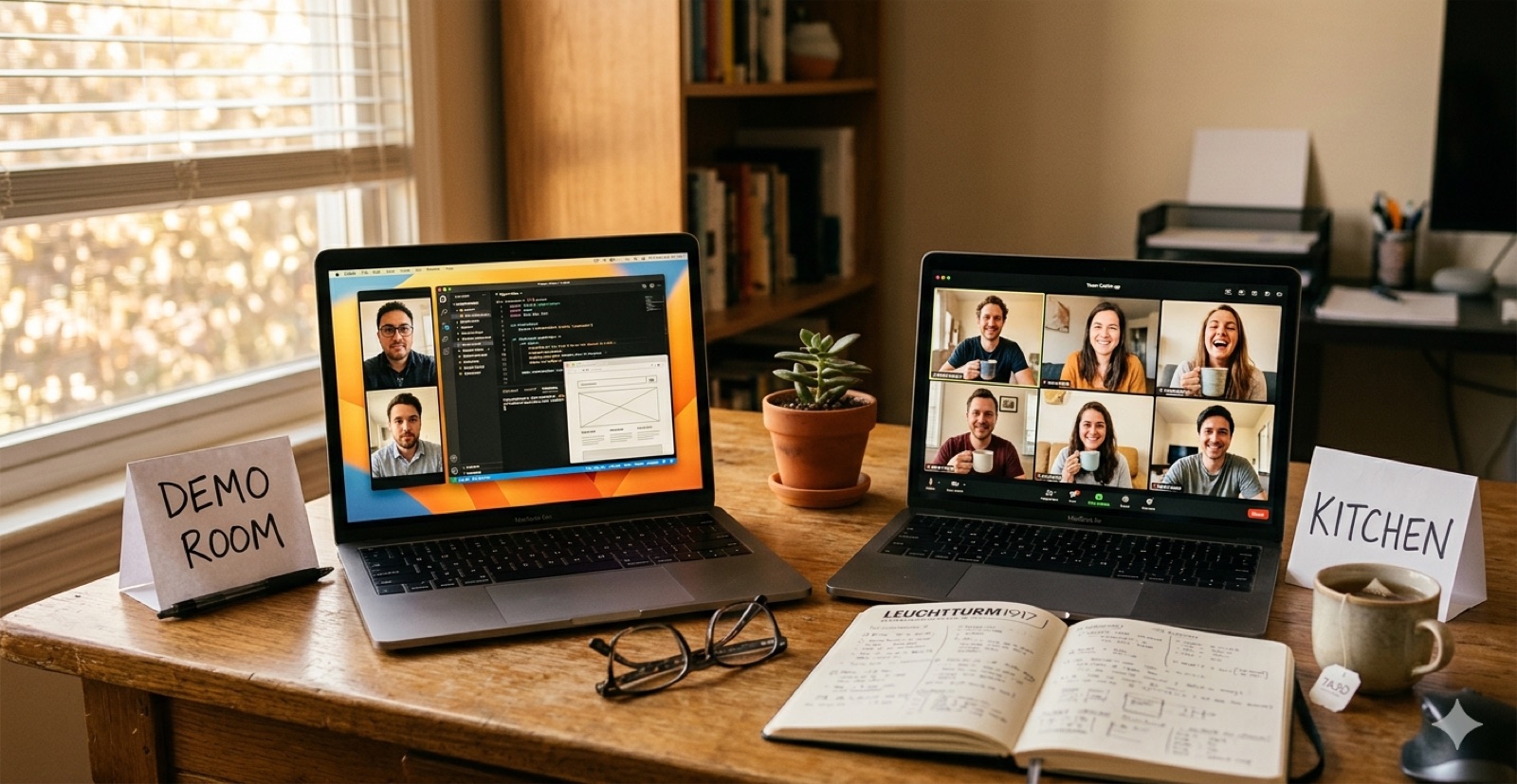
The teams I work with today don’t run daily standups any more. We have succumbed and do call them “standups”, because teams like familiarity. Some people do say what they are up to (again, it’s a ritual that is hard to break), but not everyone - that is ridiculous. Devs can say what they are up to - some say what they did yesterday, but we know that already - there are interested parties in the room and we want to know what is next, where projects are going. My favourite dev updates are “I’m continuing on my tickets” and “yesterday didn’t go as planned so same today” - short, to the point and 100% useful to a room full of people who already know. But, the most important part of our meeting is what happens throughout - How are you? Are you feeling better? How was the weekend? Any plans for your holidays? - Our “Scrum Master” is our glue, pulls people out of their shells, spots a problem, encourages small talk. This is our metaphorical gathering around the water cooler, the place we come to once a day to meet each other, ask “what’s up?” and find out that we are all part of something bigger than our own desk in a remote, isolated working environment. We have two video conference rooms - the demo room and the kitchen. Both rooms are free for all - no privacy - come and go as you please - but always be there with the rest of us at the same time. If someone can’t make the meeting, they can always report on Slack what they are doing, feel free if that is what makes them tick, but that’s not why we are there.
So, the real question is whether you’d notice if your standup quietly disappeared or if you would be upset that you couldn’t see each other. If the answer is “no, probably not” — there’s your meeting and there’s your answer.